欢迎进入山东恒能环保能源设备有限公司
欢迎进入山东恒能环保能源设备有限公司


热线电话
0531-69953988
一、引言
1. Introduction
在全球“双碳”战略加速推进与能源结构深度变革的背景下,造纸行业作为传统高耗能产业,正面临减排压力与资源化转型的双重挑战。沼气作为制浆废水厌氧处理的副产物,其热值潜力与碳中性特征使之成为造纸企业绿色转型的关键突破口。然而,当前行业普遍存在的沼气利用率低(不足60%)、能源转化模式粗放等问题,严重制约了其经济与环境价值的释放。从我自己的实践出发,原来采用的是沼气掺烧工艺,2023年4月,我们开始调研,本着“多能互补”系统思维,以沼气资源利用为核心,深度解构沼气提纯、热电联产、生物天然气制备等技术的协同创新路径。通过对比分析锅炉掺烧、沼气发电、提纯制气三大模式的能效表现与经济性,结合太阳纸业企业的实证数据,得出结论:沼气提纯技术可以通过能源品位升级(甲烷浓度>95%)、碳资产增值(CCER开发)和多元化消纳场景(车用燃气/工业燃料)构建复合价值网络,实现非常好的经济效益。
Against the backdrop of accelerated global "dual carbon" strategy and deep transformation of energy structure, the paper industry, as a traditional high energy consuming industry, is facing dual challenges of emission reduction pressure and resource transformation. Biogas, as a byproduct of anaerobic treatment of pulp wastewater, has the potential for calorific value and carbon neutrality, making it a key breakthrough for the green transformation of papermaking enterprises. However, the common problems in the current industry, such as low utilization rate of biogas (less than 60%) and extensive energy conversion mode, seriously restrict the release of its economic and environmental value. Starting from my own practice, we originally used the biogas co firing process. In April 2023, we began to investigate and, based on the "multi energy complementarity" system thinking, with the efficient utilization of biogas resources as the core, deeply deconstructed the collaborative innovation path of technologies such as biogas purification, cogeneration, and biogas production. By comparing and analyzing the energy efficiency performance and economy of the three major modes of boiler co firing, biogas power generation, and purified gas production, combined with empirical data from Sun Paper Industry, it is concluded that biogas purification technology can construct a composite value network through energy grade upgrading (methane concentration>95%), carbon asset appreciation (CCER development), and diversified consumption scenarios (vehicle gas/industrial fuel), achieving the best economic benefits.
二、沼气特性概述
2、 Overview of Biogas Characteristics
2.1沼气来源--厌氧处理工艺链(1)目前造纸废水处理流程:初沉池→调节池→UASB/IC反应器→好氧处理,其中UASB反应器产气占比达70%以上;
2.1 Source of Biogas - Anaerobic Treatment Process Chain (1) Currently, the papermaking wastewater treatment process includes: primary sedimentation tank → regulating tank → UASB/IC reactor → aerobic treatment, with UASB reactor producing more than 70% of the gas;
(2)造纸污泥的协同处理:造纸污泥(含纤维残渣)经中温(35-37℃)消化,产气周期15-20天,VS(挥发性固体)降解率与产气量呈正相关(VS每增加1%,产气量提升0.5m/t);
(2) Collaborative treatment of papermaking sludge: papermaking sludge (including fiber residue) is digested at medium temperature (35-37 ℃), with a gas production cycle of 15-20 days. The degradation rate of volatile solids (VS) is positively correlated with gas production (for every 1% increase in VS, the gas production increases by 0.5m/t);
(3)原料差异性影响:废纸制浆沼气含硫量高(HS>1500ppm),原生浆沼气硫含量低(HS<800ppm);非木浆(如竹浆)沼气甲烷含量较木浆低3-5个百分点。2.2沼气成分与热值的动态分析
(3) The impact of differences in raw materials: the sulfur content of waste paper pulp biogas is high (H-S>1500ppm), while the sulfur content of primary pulp biogas is low (H-S<800ppm); The methane content of non wood pulp (such as bamboo pulp) biogas is 3-5 percentage points lower than that of wood pulp. 2.2 Dynamic analysis of biogas composition and calorific value
(1)硫化氢处理必要性:HS浓度>200ppm时,燃气设备腐蚀速率加快3倍(参考《燃气轮机腐蚀控制标准GB/T 14090》);脱硫成本占比:生物脱硫法0.1-0.2元/m,化学吸收法0.3-0.5元/m;
(1) The necessity of hydrogen sulfide treatment: When the concentration of H2S is greater than 200ppm, the corrosion rate of gas equipment accelerates by three times (refer to the "Gas Turbine Corrosion Control Standard GB/T 14090"); Cost proportion of desulfurization: 0.1-0.2 yuan/m for biological desulfurization method, 0.3-0.5 yuan/m for chemical absorption method;
(2)热值波动管理:甲烷浓度每下降5%,锅炉热效率降低2%;典型热值应用场景:发电需>22MJ/m,车用燃气需>31MJ/m(需提纯至CH>90%)。2.3体量测算模型(1)产气量计算公式:Q =k×COD负荷×η×R其中:
(2) Heat value fluctuation management: For every 5% decrease in methane concentration, the boiler thermal efficiency decreases by 2%; Typical application scenarios for calorific value: power generation requires>22MJ/m Does car gas require>31MJ/m (To be purified to CH>90%). 2.3 Volume Calculation Model (1) Gas Production Calculation Formula: Q=k × COD Load × η × R Where:
k:产气系数(0.35-0.45m/kg COD)
k: Gas production coefficient (0.35-0.45m/kg COD)
η:COD去除率(85-95%);
η: COD removal rate (85-95%);
R:运行稳定性系数(0.8-0.95);
R: Operating stability coefficient (0.8-0.95);
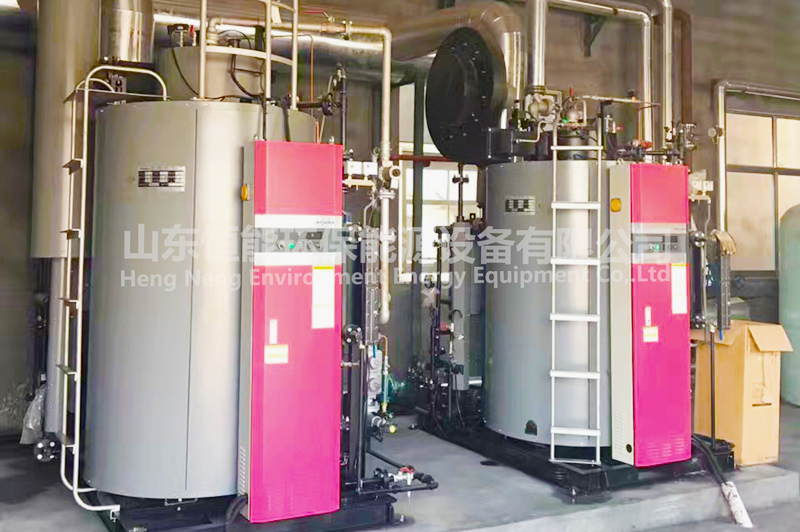
(2)沼气利用规模经济阈值:提纯项目盈亏平衡点:沼气量≥1500m/d;发电项目经济性拐点:设备利用率>75%(年运行6500小时)。三、沼气利用模式分析3.1自备热电厂锅炉掺烧模式掺烧模式是目前非常普遍的沼气利用模式,通过污水厂厌氧塔的沼气稳压罐及后面的风机,通过管道送到电厂的分气缸,然后通过燃烧器后进入锅炉的燃烧系统。此模式的关键问题点我认为有两处:一是掺烧沼气虽然投资小、系统简单,但是其在锅炉内部的掺烧对锅炉产生氮氧化物有很大影响,通过我实际的情况来看,一旦投入掺烧系统,脱硝用氨水量马上增加。如果有两个沼气燃烧器运行,就相当于增加了两个燃烧源,大大影响锅炉氮氧化物的产生量。
(2) Scale economy threshold for biogas utilization: breakeven point for purification projects: biogas volume ≥ 1500m /d; Economic turning point of power generation projects: equipment utilization rate>75% (annual operation of 6500 hours). 3、 Analysis of Biogas Utilization Mode 3.1 Co firing Mode of Self provided Thermal Power Plant Boiler Co firing Mode is currently the most common biogas utilization mode. It is sent through the biogas stabilizing tank of the anaerobic tower in the sewage plant and the fan behind it, through pipelines to the power plant's gas separation cylinder, and then enters the combustion system of the boiler after passing through the burner. I think there are two key issues with this model: firstly, although the investment in co firing biogas is small and the system is simple, its co firing inside the boiler has a significant impact on the production of nitrogen oxides. Based on my actual situation, once the co firing system is put into use, the amount of ammonia water used for denitrification immediately increases. If there are two biogas burners running, it is equivalent to adding two combustion sources, greatly affecting the production of nitrogen oxides in the boiler.
二是沼气热值高,但是进入炉膛后,实际产生的热效率的大小需要试验确认,也就是说,其产生的热效率并不等于锅炉热效率。沼气在燃煤锅炉内燃烧充分,但是到尾部换热却不能完全完成。我们组织了试验,沼气投入锅炉,稳定燃烧后,在尾部烟气处测量组份,没有可燃元素,那就说明沼气的燃尽率是100%;但同时发现锅炉的排烟温度马上上升,排烟热损失增加,说明在锅炉内沼气燃烧热效率是低于煤炭燃烧热效率的。下面是实际的简单试验的结果:
The second reason is that biogas has a high calorific value, but the actual thermal efficiency generated after entering the furnace needs to be confirmed through experiments, which means that the thermal efficiency generated does not equal the boiler thermal efficiency. Biogas is fully burned in coal-fired boilers, but the heat exchange at the tail cannot be fully completed. We organized an experiment and put biogas into the boiler. After stable combustion, the composition was measured at the tail flue gas. If there were no combustible elements, it means that the combustion rate of biogas is 100%; But at the same time, it was found that the exhaust temperature of the boiler immediately increased, and the exhaust heat loss increased, indicating that the thermal efficiency of biogas combustion in the boiler is lower than that of coal combustion. Here are the actual results of a simple experiment:
(1)沼气输入热量:Q1=单位小时沼气掺烧量*沼气低位发热量=1400m3*24.4mj/m3=81.58万大卡;
(1) Biogas input heat: Q1=unit hour biogas co firing amount * biogas low-level heat generation=1400m3 * 24.4mj/m3=815800 kcal;
(2)排烟热损失:Q2=12.8万大卡
(2) Smoke exhaust heat loss: Q2=128000 kcal
(3)沼气燃烧热效率计算:η=1-Q/Q1=77.6%在我们这台特定锅炉中掺烧,沼气在锅炉实际热效率为77.6%。如果5000大卡煤炭价格为800元,那一立方沼气的经济价值是:24.4/4.1868/5000*800*0.77=0.72元。另外,需要提醒的是:“碳减排盲区”:掺烧模式因无法准确计量沼气替代率,导致CCER(国家核证自愿减排量)开发难度大。
(3) Calculation of thermal efficiency of biogas combustion: η=1-Q/Q1=77.6%. In our specific boiler, when co fired, the actual thermal efficiency of biogas in the boiler is 77.6%. If the price of 5000 kcal coal is 800 yuan, the economic value of one cubic meter of biogas is 24.4/4.1868/5000 * 800 * 0.77=0.72 yuan. In addition, it should be noted that there is a "carbon emission reduction blind spot": the co firing mode is difficult to develop due to the inability to accurately measure the biogas substitution rate, making CCER (National Certified Voluntary Emission Reduction) challenging.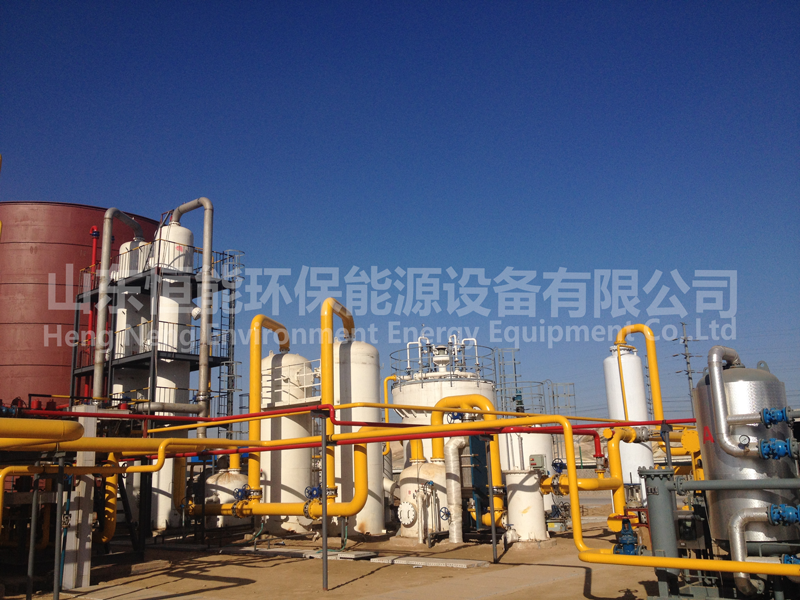
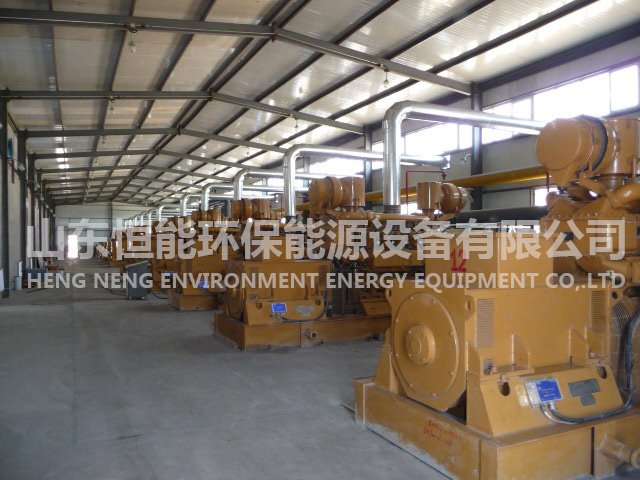
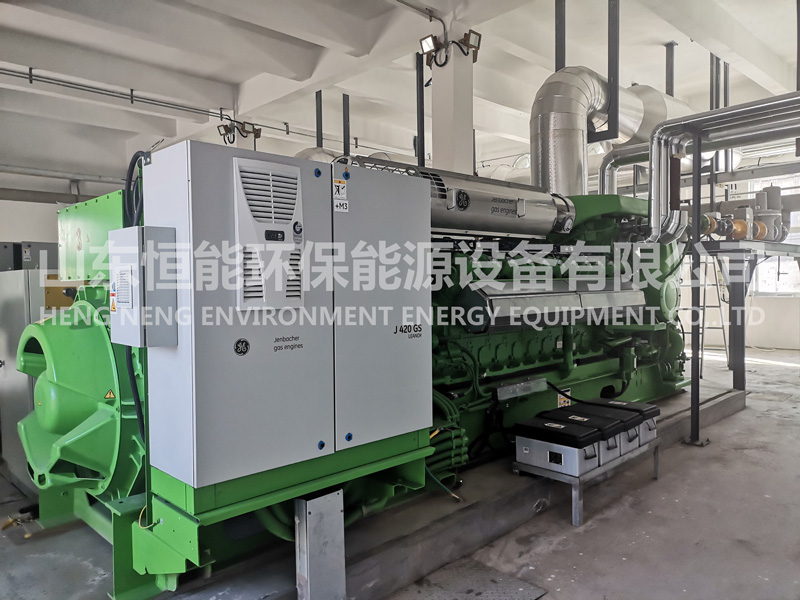
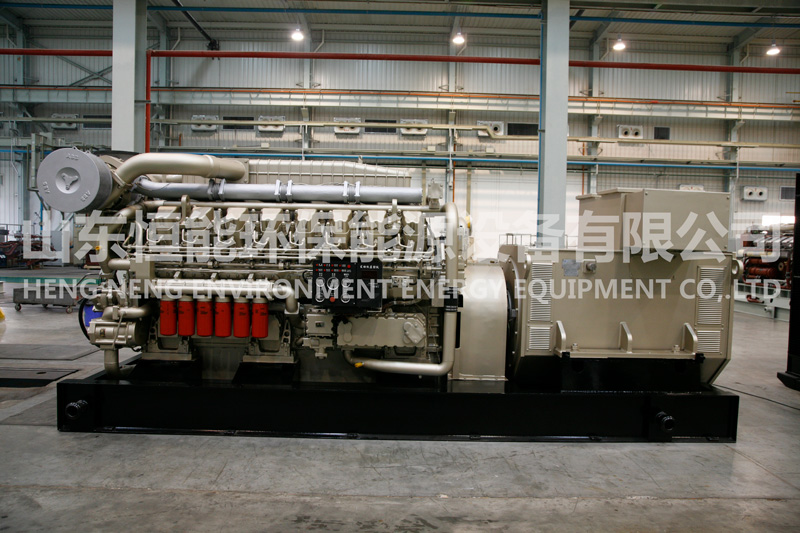
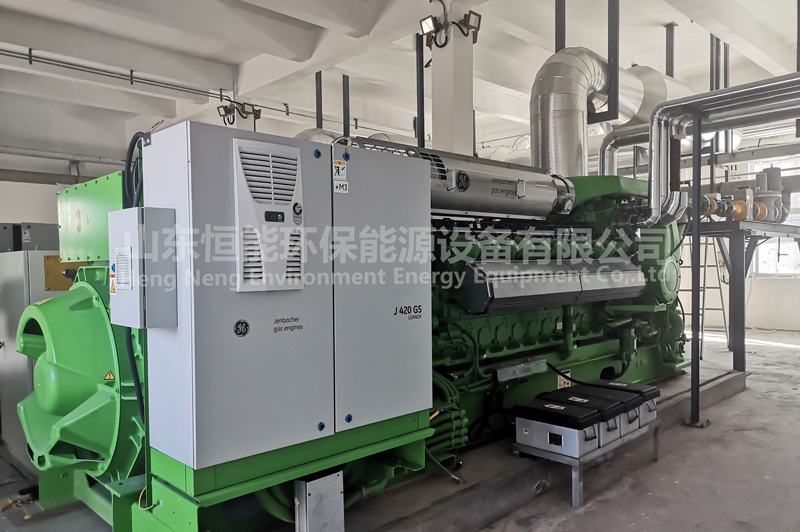
3.2沼气发电模式考虑到现在企业经济情况不景气,我们开始的项目原则就定位为“乙方投资,乙方运维”的模式,我们把沼气交于对方,对方提供电力和低压工业用蒸汽给我方。具体配置及经济性核算如下:沼气低热值MJ24.4日供应沼气量m/d100000机组配置功率Mw13.80发电量Kw13310机组供电量Kw12645年运行小时数h8000机组每小时蒸汽量t/h7.50供电供汽年度总收益万元/年3739.单位沼气价值元1.123.3沼气提纯模式沼气提纯制生物天然气(Bio-CNG)模式,是通过膜分离、PSA(变压吸附)或水洗工艺将沼气甲烷浓度提纯至90%~97%,生产车用燃气或工业燃料。此模式附加值非常高(生物天然气售价达3.5~4.5元/m),且可开发碳信用(CCER收益15~30元/吨CO)。下表是目前各提纯工艺的优劣势的对比分析表:工艺名称甲烷得率能耗适用规模核心优势主要局限变压吸附90%~95%0.25~0.35>1000m/d自动化高,纯度稳定吸附剂更换成本高膜分离80%~88%0.15~0.25200~2000m/d低能耗,模块化灵活膜污染风险,预处理严格水洗法85%~90%0.3~0.5500~3000m/d脱碳有效,工艺简单水耗大,废水处理难化学吸收(胺法)>99%0.4~0.6>1500m/d高纯度,同步脱硫溶剂损耗,环保压力深冷分离>99.5%0.8~1.2>5000m/d生产LNG,附加值投资与能耗双高能耗单位:(kWh/m)
3.2 Considering the current economic downturn of the enterprise, our initial project principle was positioned as a "Party B investment, Party B operation and maintenance" model. We handed over the biogas to the other party, who provided us with electricity and low-pressure industrial steam. The specific configuration and economic calculation are as follows: the low calorific value of biogas MJ24.4, the daily supply of biogas m/d100000, the unit configuration power Mw13.80, the power generation Kw13310, the unit power supply Kw12645, the operating hours h8000, the hourly steam volume t/h7.50, the annual total revenue of power supply steam is RMB 3739. The unit biogas value is RMB 1.123.3. The biogas purification mode is to purify biogas to produce bio natural gas (Bio CNG), which purifies the methane concentration of biogas to 90%~97% through membrane separation, PSA (pressure swing adsorption) or water washing process, and produces vehicle gas or industrial fuel. This mode has the highest added value (the selling price of biogas reaches 3.5-4.5 yuan/m), and can also develop carbon credits (CCER income of 15-30 yuan/ton CO). The following table is a comparative analysis of the advantages and disadvantages of various purification processes at present: process name, methane yield, energy consumption, applicable scale, core advantages mainly limited to pressure swing adsorption 90%~95%, 0.25~0.35>1000m/d, high automation, stable purity, high adsorbent replacement cost, membrane separation 80%~88%, 0.15~0.25, 200~2000m/d, low energy consumption, modular flexible membrane pollution risk, strict pre-treatment, water washing method 85%~90%, 0.3~0.5500~3000m/d, complete decarbonization, simple process, high water consumption, difficult chemical absorption of wastewater treatment (amine method)>99%, 0.4~0.6>1500m/d, high purity, synchronous desulfurization solvent loss, environmental pressure cryogenic separation>99.5%, 0.8~1.2>5000m/d for LNG production, added value. High investment and energy consumption double high energy consumption unit: (kWh/m)
四、结论
4、 Conclusion
通过现场调研,我们去了杭州临港的现场考察,拿到第一手资料,所以经过综合论证,决定采用“沼气提纯”的模式来进行沼气资源的利用。从经济性角度看,每立方的沼气产生的价值为:掺烧模式0.72元,沼气发电模式约为1.12元,而沼气提纯模式,在目前能源条件下,由乙方负责投资和运维的情况下,每方沼气的价值将大于前面两种模式。所以,我们选择了沼气提纯模式来运作此项目,也是企业能源工作在“多能互补”方面做出的一大有益尝试。目前,太阳纸业是国内唯一明确披露沼气提纯生产生物天然气的造纸企业,其项目覆盖国内外多个基地,技术成熟且效益显著。根据2019年数据,其山东基地的一、二期项目采用EPC模式建设,沼气处理能力为2×30,000立方米/日,提纯后的生物天然气产量可达2×20,000立方米/日以上。截至2019年,山东基地已累计生产生物天然气1,385万立方米,直接并入厂区市政燃气管网,用于自用燃料,显著降低对外部天然气的依赖。以上,即关于造纸企业沼气的利用项目的实践总结,希望对相关企业的能源管理及项目决策起到一定的参考与借鉴作用。
Through on-site research, we went to Hangzhou Lingang for on-site investigation and obtained first-hand information. Therefore, after comprehensive evaluation, we have decided to adopt the "biogas purification" mode for efficient utilization of biogas resources. From an economic perspective, the value generated per cubic meter of biogas is: 0.72 yuan for co firing mode, about 1.12 yuan for biogas power generation mode, and the value per cubic meter of biogas purification mode will be greater than the previous two modes under current energy conditions, with Party B responsible for investment and operation. So, we chose the biogas purification mode to operate this project, which is also a beneficial attempt made by the enterprise's energy work in the aspect of "multi energy complementarity". At present, Sun Paper is the only paper-making enterprise in China that has explicitly disclosed the production of biogas through biogas purification. Its projects cover multiple bases both domestically and internationally, with mature technology and significant benefits. According to 2019 data, the first and second phases of its Shandong base project will be constructed using EPC mode, with a biogas processing capacity of 2 × 30000 cubic meters per day and a purified biogas production of over 2 × 20000 cubic meters per day. As of 2019, the Shandong base has produced a total of 13.85 million cubic meters of bio natural gas, which has been directly integrated into the municipal gas pipeline network in the factory area for self use as fuel, significantly reducing dependence on external natural gas. The above is a practical summary of the efficient utilization project of biogas in papermaking enterprises, hoping to provide some reference and guidance for energy management and project decision-making of related enterprises.
 企业二维码
企业二维码


 2026-02-21







 鲁公网安备37011202000764号号